


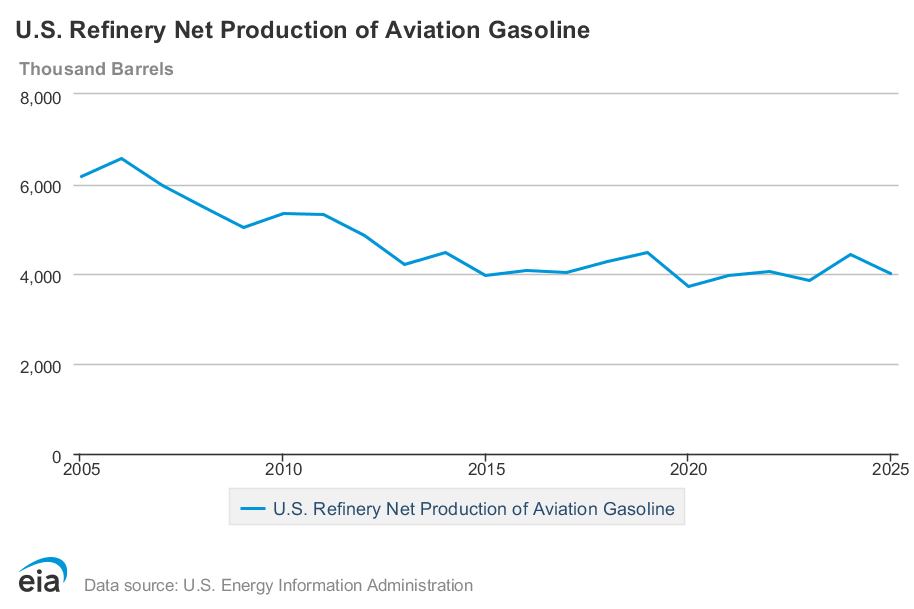
Quick answer: No nationwide 100LL shortage is likely through 2027. Diesel supply issues (significant export demand) don’t compete with avgas production. Regional gaps are possible: avgas is a tiny slice of total refinery output, and refiners can profit more from blending its high-octane component into ordinary gasoline. U.S. avgas output has stayed roughly stable for the past ten years, but production is now concentrated among fewer refiners. Plan fuel stops with margin, and call ahead.
Discussion: You plan a cross-country flight and pick your fuel stop based on the price and availability shown in your EFB. When you land and ask the lineman for a top-off, he shrugs: “Truck’s been dry for four days. Supplier says it’s coming, but nobody’s given us a date. I keep telling the front desk to update the website, sorry.” You’ve got enough fuel to reach an airport that does have avgas, but not enough to make your original plan work, and the hour you’d budgeted for lunch is gone, spent hunting for the nearest field that still has fuel in the ground.
Oil prices move. Refineries idle units for maintenance or economics. Every so often that ripple reaches your fuel stop. That kind of miss is more likely to show up as a quiet, regional gap than a dramatic nationwide outage. National 100LL output has not been collapsing, historically or recently. What has gotten thinner is the margin for error: fewer plants make the fuel, some regions no longer produce it at all, and a deferred batch or a missed truck can leave a local pump dry. That’s worth planning around before you pack a bag for a cross-country. Oil prices usually change what you pay more than whether the truck shows up at all.
The 2024 FAA Reauthorization Act calls for safely eliminating the use of leaded aviation gasoline (primarily 100LL) in piston-engine aircraft by the end of 2030 (end of 2032 for Alaska). The other factor here is that the sole manufacturer of the lead additive (TEL) may stop production prior to those dates.
What Has Actually Changed in the 100LL Supply Chain?
Avgas production has been consolidating for years, and that consolidation, not a looming crisis, is the real story. The number of U.S. refineries producing 100LL has fallen over the past two decades to a small set of plants run by a few companies; however, avgas output has remained relatively steady for the past decade. It is estimated that U.S. production occurs at five to seven plants, plus some import into the Northeast. Entire regions of the country no longer produce any avgas at all, and the refiners that still make it are increasingly concentrated along the Gulf Coast, with a smaller West Coast slice and little or no ongoing Midwest or East Coast production.
That concentration is what matters, not disappearance. It doesn’t mean 100LL is going away. It means the margin for error has gotten thin. When more plants made avgas, one producer stepping back barely registered nationally. When only a handful of companies make it, one of them deferring production can leave a whole region short, because there’s no longer a deep bench of alternate suppliers to absorb the gap.
At the same time, the broader U.S. refining system has been running tighter than it has in years, having lost capacity to notable plant closures, with the West Coast especially tight. That’s a general refining-system fact, not a 100LL-specific collapse. This is a supply chain that has gotten leaner everywhere, and a specialty product like avgas is the part of that chain with the least slack built in.
Why Would Refiners Deprioritize Avgas When Pilots Still Need It?
Refiners deprioritize avgas because the same high-octane blending component that makes 100LL also makes ordinary gasoline more valuable, and gasoline is by far the bigger business. Avgas is built from aviation alkylate, a high-octane stream refiners also use to boost the octane of the everyday gasoline sold at every corner station in the country. That blendstock isn’t exclusive to aviation. It’s contested.
One gallon of aviation alkylate diverted into the gasoline pool can lift several gallons of ordinary gasoline into a higher-value, higher-octane product. Industry commentary has long used a rough three-to-one framing: a gallon not put into avgas can free enough alkylate to upgrade roughly three gallons of conventional gasoline toward a higher-value blend. Aviation-grade alkylate is also a particular cut of alkylate, not identical to every gallon of ordinary alkylate a refinery produces. Avgas does sell at a premium over motor gasoline at the refinery gate, but that premium has to cover dedicated tankage, specialized handling, product liability, and a batch-certification process that ordinary gasoline never needs. Typical gasoline margins are thin to begin with, so when gasoline profitability widens even modestly, the math can tip: that same barrel of alkylate is worth more staying in the mogas pool than going into a specialty product that represents a rounding error of total output.
Refiners have described this trade-off in industry trade press for years. It isn’t a plan aimed at pilots. It’s an ordinary business decision, made the same way any manufacturer allocates a scarce input, and general aviation happens to land on the losing end of that calculation more often than it used to.
What Is a Gasoline Crack Spread, and How Can It Affect 100LL?
A crack spread is the difference between crude cost and the value of the finished products made from that barrel. A gasoline/distillate, or “3-2-1,” crack mixes gasoline and diesel; the number that matters for this story is the gasoline side. When gasoline is unusually profitable relative to crude, the high-octane blendstock is more attractive in the mogas pool than in a 100LL batch. That’s one input into a scheduling decision, not the single number that decides whether your local refiner runs avgas.
Here’s the part that catches most pilots off guard: avgas isn’t produced continuously. It’s built in scheduled batches, blended and certified in discrete runs rather than flowing off the line around the clock. If a refiner looks at a wide gasoline crack spread and decides the timing is bad, it can simply not schedule the next avgas campaign. There’s no press release, no announced closure, no dramatic news story. The batch just doesn’t happen, and the gap doesn’t show up until tanks downstream start running low.
That mechanism is real and worth understanding, but it shouldn’t be read as evidence that skipped campaigns are already showing up as a national production slide. A dry truck at your local FBO is often a distribution or inventory problem, not proof that a refiner canceled a run.
A common misconception is that avgas prices and supply move in lockstep with pump gasoline, since both come from crude oil. They don’t move in lockstep. Avgas is a specialty batch product with its own economics, and it can tighten or loosen on a different timetable than the price sign at the corner gas station. Wholesale avgas still tends to track crude and motor gasoline with a specialty premium; it isn’t fully independent.
What Should Flight Schools and CFIs Watch For Now?
Flight schools should watch producer concentration and local supplier redundancy, because training operations burn far more fuel per week than an individual owner and have far less flexibility to simply wait out a regional shortage. A school running a fleet of trainers at high utilization can’t easily pause instruction for two weeks while a supplier reschedules a production run.
Schools are also more exposed to price volatility than owners flying occasionally, since fuel cost feeds directly into hourly rental rates and, ultimately, into how affordable flight training is for students. A CFI managing a training schedule should know whether the school’s fuel supplier sources from a single refiner or region, because that single-point dependency is the vulnerability worth mapping now. Localized dry tanks at smaller airports are common enough to plan for.
Should Prospective Student Pilots Worry About Avgas Availability?
No, avgas availability concerns are not a good reason to delay starting flight training. The risk profile described here is a regional, occasional supply hiccup, not a reason to believe 100LL will become unavailable or that flight schools will be unable to operate. Flight schools have managed fuel logistics challenges for decades and are generally positioned to absorb short-term supply disruptions without shutting down training.
The separate question of the multi-year transition away from leaded 100LL, including candidate unleaded fuels, airport infrastructure, and the later-decade phase-out goal, is real, but it isn’t a reason to sit on the sidelines in the meantime. Schools will manage that change the way they manage every other logistics problem: ahead of the student, not as the student’s homework.
Student pilots weighing the cost and timing of training should focus on the fundamentals that actually determine success: choosing a solid ground school, finding a CFI who fits their schedule, and building consistent flight frequency with simulator support. When fuel costs are high, a Part 141 school may become more affordable, as up to 7 hours of simulator training can be substituted for the 35-hour minimum requirement. Part 61 training is limited to a maximum of 2.5 hours of simulator time toward the 40-hour minimum.
Bottom line: fuel supply risk belongs on a flight school’s radar, not on a prospective student’s list of reasons to wait.
What Can Pilots, Owners, and Schools Do Now to Prepare?
None of these steps require alarm, only ordinary good planning. Build the following habits into your routine:
- Check fuel availability at your destination and alternate before every cross-country flight, not just the departure airport, especially on longer trips through less-trafficked areas.
- Call ahead to confirm fuel is actually in the tank, not just listed as available online, particularly at smaller FBOs that may not update their status in real time.
- Build a fuel-stop alternate into every flight plan, one with a currently known, reliable source of 100LL, so a dry pump doesn’t turn into a scramble.
- Check current NOTAMs, since the FAA uses them to flag fuel unavailability at specific airports; a quick check before departure can save you an unplanned diversion.
- Monitor live fuel-price sources rather than relying on memory or last month’s price, since avgas pricing can move on a different timetable than pump gasoline prices.
- Flight schools should map supplier redundancy now, identifying at least one backup fuel source that doesn’t depend on the same refiner or delivery route as the primary supplier.
- CFIs should build fuel-planning discussion into cross-country training, so students learn to check availability and build margin as a normal habit, not an emergency skill.
Frequently Asked Questions
Will there be an avgas shortage?
A nationwide 100LL shortage is not the likely outcome. The more realistic risk is a regional, temporary gap at specific airports if a producer defers a scheduled batch or a trucking disruption interrupts delivery. Because so few companies make avgas today, a single disruption can be felt more sharply in the affected region. That’s different from a countrywide outage affecting every pilot at once. High oil prices are more likely to show up in the price per gallon than in a missing truck.
Why are refiners cutting back on avgas production?
“Cutting back” is the wrong way to frame it if you mean total national barrels. Remember that previous chart on avgas production from the EIA? What has actually contracted is the number of plants and regions that make 100LL. Refiners can still deprioritize a given batch because aviation alkylate is often more profitable blended into everyday motor gasoline. Avgas is a tiny fraction of total refinery output, so when gasoline margins widen, the opportunity cost of a specialty run rises. That’s an ordinary business decision, not a campaign against general aviation.
Will 100LL avgas prices keep going up?
Avgas prices are likely to stay elevated relative to motor gasoline as production concentrates among fewer refiners, but no one can guarantee a specific trend with certainty. Prices respond to refining margins, regional supply, and delivery logistics, all of which can shift on a different timetable than pump gasoline prices. Check current, up-to-date fuel-price sources before you fly rather than relying on last season’s numbers.
How can flight schools prepare for possible avgas supply problems?
Flight schools should map their fuel supplier’s source and identify a backup that doesn’t depend on the same refiner or delivery route. Because schools burn fuel at a much higher rate than individual owners, even a short regional disruption can affect a training schedule. Building supplier redundancy, tracking local inventory trends, and communicating proactively with students about local changes are the most practical steps a school can take now. As mentioned earlier, maximizing simulator usage, such as in Gleim’s FAA-certified BATD, can offset some of the flight-hour requirements.
Should I wait to start flight training because of avgas availability concerns?
No. The risk described here is regional and occasional, not a reason to delay starting flight training. Flight schools have managed fuel logistics challenges for years and are generally equipped to handle short-term disruptions without pausing instruction. Prospective students are better served focusing on choosing a solid ground school and a CFI who fits their schedule than on avgas supply headlines.
Keep Building Your Foundation, Whatever Fuel Prices Do
Supply chains shift. Markets tighten and loosen. What doesn’t change is the value of knowing your systems, your regulations, and your aircraft cold, so you can make good decisions no matter what the ramp looks like on a given day. Since 1980, Gleim Aviation has helped pilots build that foundation with the same straightforward, mastery-based approach: Online Ground School and FAA Knowledge Test Prep, built to get you through your checkride and into the air with confidence. Continue your preparation at GleimAviation.com. Onward and upward.